
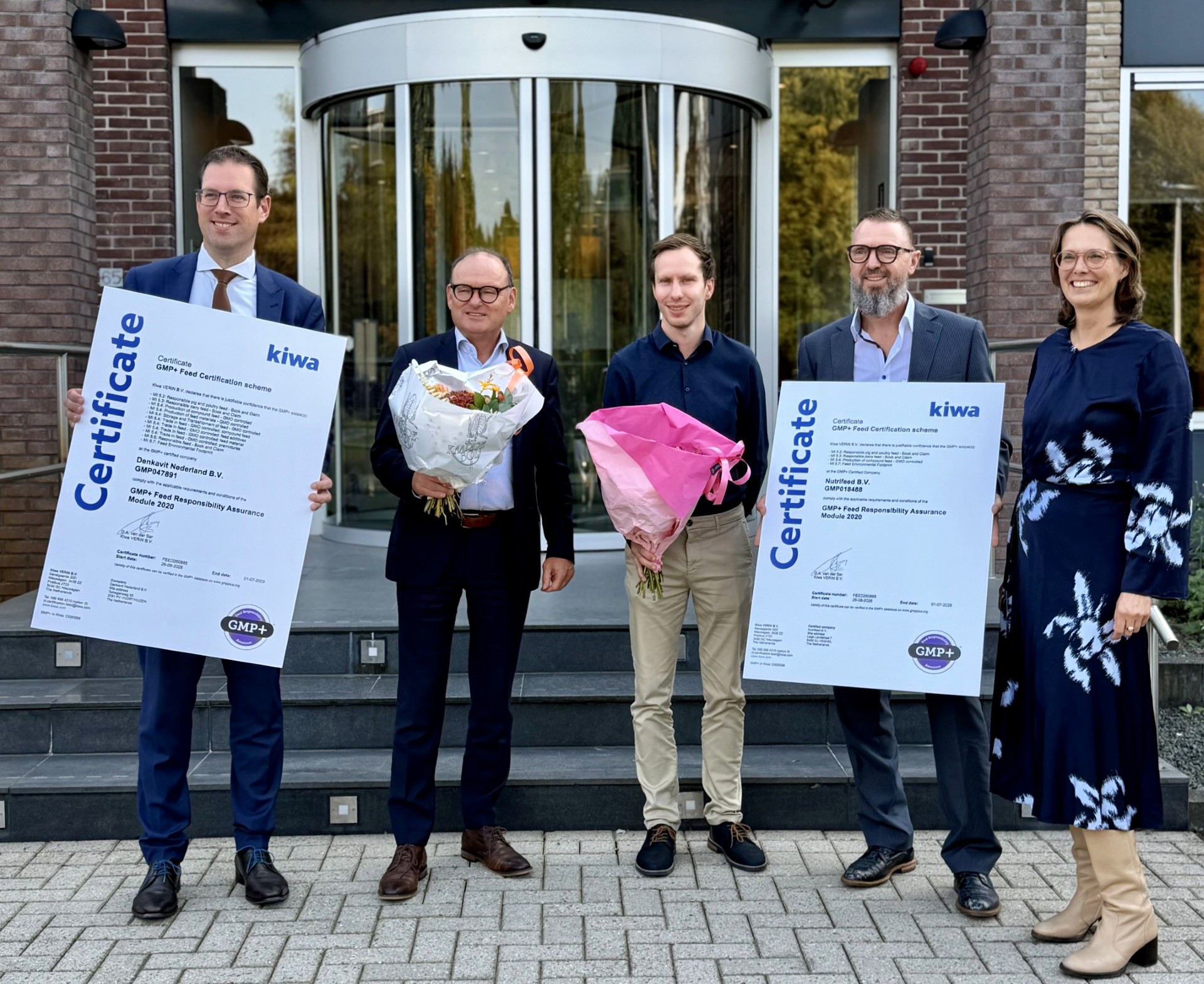
This month I was delighted to celebrate that Denkavit, and their sister company Nutrifeed, have become the first companies to be certified under the GMP+ MI5.7 Feed Life Cycle Assessment (LCA) standard.
This is an important milestone for the sector. The idea of a standardised and comparable approach to measuring the environmental footprint of animal feed is no longer an abstract concept – it is being used in practice, today.
Buyers are asking for reliable environmental data
MI5.7 Feed LCA was developed in response to a clear demand from the sector: a harmonised and independently verified way to calculate and communicate the environmental impact and carbon footprint of feed.
For many in our industry, the immediate driver is customer demand. Buyers, food companies and retailers want comparable environmental and carbon footprint data for their reporting needs. That means feed companies need to be able to answer practical questions. What is the footprint of this feed? How has it been calculated? Are the results comparable year on year? And can the customer trust the data behind it?
Customers throughout the food chain have started asking these questions, and being able to answer is increasingly necessary in many markets. MI5.7 Feed LCA gives certified companies involved in compound feed, premixtures, feed materials, feed additives, and feed trade a common approach to providing those answers. It is based on recognised Life Cycle Assessment principles, aligns with the guidelines of the Product Environmental Footprint Category Rules (PEFCR) for feed, and includes independent certification to add confidence that a consistent and comparable approach was used.
But building this capability now is about more than giving customers what they need to tick regulatory boxes. It is about a feed supply chain that is resilient enough to withstand disruption over the long term.
Future-proofing
This is where I see the true value of Feed LCA: it gives you better insights. Better insights supports better decisions and, ultimately, helps your company prepare for the future.
Reliable information about the ingredients and processes behind your environmental impact helps you focus your efforts. Yes, you – and your customers – need the data for reporting, but frontrunners will be using this information to work differently with their suppliers, address hotspots in production, or find solutions to de-risk their supply chains.
Data quality is central to this. If companies use different methodologies, assumptions, and data sources, it becomes difficult to compare results or understand which changes genuinely improve performance. A harmonised approach gives the sector a meaningful basis for conversations with customers and supply-chain partners because everyone has greater confidence in the information being shared.
GMP+ International can support this by providing the standard, recognising calculation tools, working with Certification Bodies, and developing training and guidance. But companies themselves need to build the capability, improve their data, and apply the standard in practice.
It’s in your hands
Feed companies asked us to help them address this challenge. We worked closely with industry experts, subcommittees, think tanks, OVOCOM, and consultation groups to ensure the standard was practical, workable, and valuable. And now, it’s in your hands.
If customers are already asking you for environmental data, MI5.7 provides a way to respond with independently verified information. If those requests have not yet arrived, this is an opportunity to prepare before they do.
We have practical support in place to help you get started:
E-learning
On the GMP+ Academy you can find ‘MI5.7 Feed LCA: From Calculation to Certification’: an e-learning module to help you understand MI5.7, identify the data, systems, and tools you need, and help you communicate the results.
We are also developing two more e-learning modules. One is specifically for auditors, focused on knowledge development and capacity building based on real-life case studies. Another will be launched in October together with Wageningen University, as an introduction to PEFCR and LCA principles for feed companies. In November you will even be able to join a live webinar giving you an opportunity to put your questions directly to experts. Watch this space!
Guidance
Looking for practical answers to your questions? Take a look at 6 FAQs on MI5.7 Feed LCA.
GMP+ International has already recognised multiple commercial, in-house and association-based calculation tools. Want to know which calculation tools are recognised under MI5.7? Read our guide to MI5.7 LCA calculations tools.
And you can always contact the GMP+ Helpdesk.
Scheme documents
The full scheme documents are publicly available in multiple languages: MI5.7 Feed life cycle assessment (LCA).
Next steps?
Contact your Certification Body.
When you speak, we act
I really cannot stress enough that when we say GMP+ International listens to the community, we mean it. The Feed LCA standard is a prime example; companies told us they needed a more credible and harmonised approach to sustainability data, and we played our role as an independent standard setter, convened the sector, and found a workable solution. And now you have a chance to be heard again.
We have launched our annual stakeholder survey, with the support of independent research agency Ipsos I&O. This survey is not just a way for us to measure satisfaction. It helps us understand where you need our support and what we should improve or develop next.
You can find the GMP+ International Ipsos survey here.
The first Feed LCA certificates are an important milestone, but the real value will come as more companies use this common, trusted approach. It will help them respond to their customers’ needs while improving their own data and underpinning better decisions for the future. MI5.7 was shaped together with the sector, but its impact depends on companies putting it into practice.
I hope Denkavit and Nutrifeed will soon be the first of many.